

Filter Emission Control Systems
Understanding baghouses and their role in visible emissions compliance
Baghouse filter introduction
Filter emission control systems, also known as baghouses or Air Pollution Control Equipment (APC), use different mechanisms to capture, separate, and filter dust. Baghouses come in variable sizes and are used in many industries throughout the world. The three basic types of filter emission control systems are outlined below.
The role of quick-checks and filter emission control systems »
Why quick-checks are an important part of your Compliance Assurance Monitoring (CAM)
Mechanical shaker
A mechanical shaker is used to shake the bag as one would shake out or beat a rug to remove accumulated dirt. A timer or an increase in pressure drop across the baghouse are two typical mechanisms that initiate a cleaning cycle. Systems with low flow and pressure would not utilize the pressure drop mechanism.
The emission is typically accumulated on the filter media and when shaken off, falls into a hopper or, if sufficiently light, is lifted back into the filter media. The cleaning cycle does not significantly alter emission levels even in the event of failure of the media or supporting structure.
No matter how frequent the shaking, when the accumulated emission is removed it is not generally noticeable because the dirty side is not much greater in airborne emission than during normal operation. When utilizing Method 9 or Method 22, because the sun is at the back of the observer, emission levels must increase to a substantial level to be visually noticed. That is where quick-checks become important.
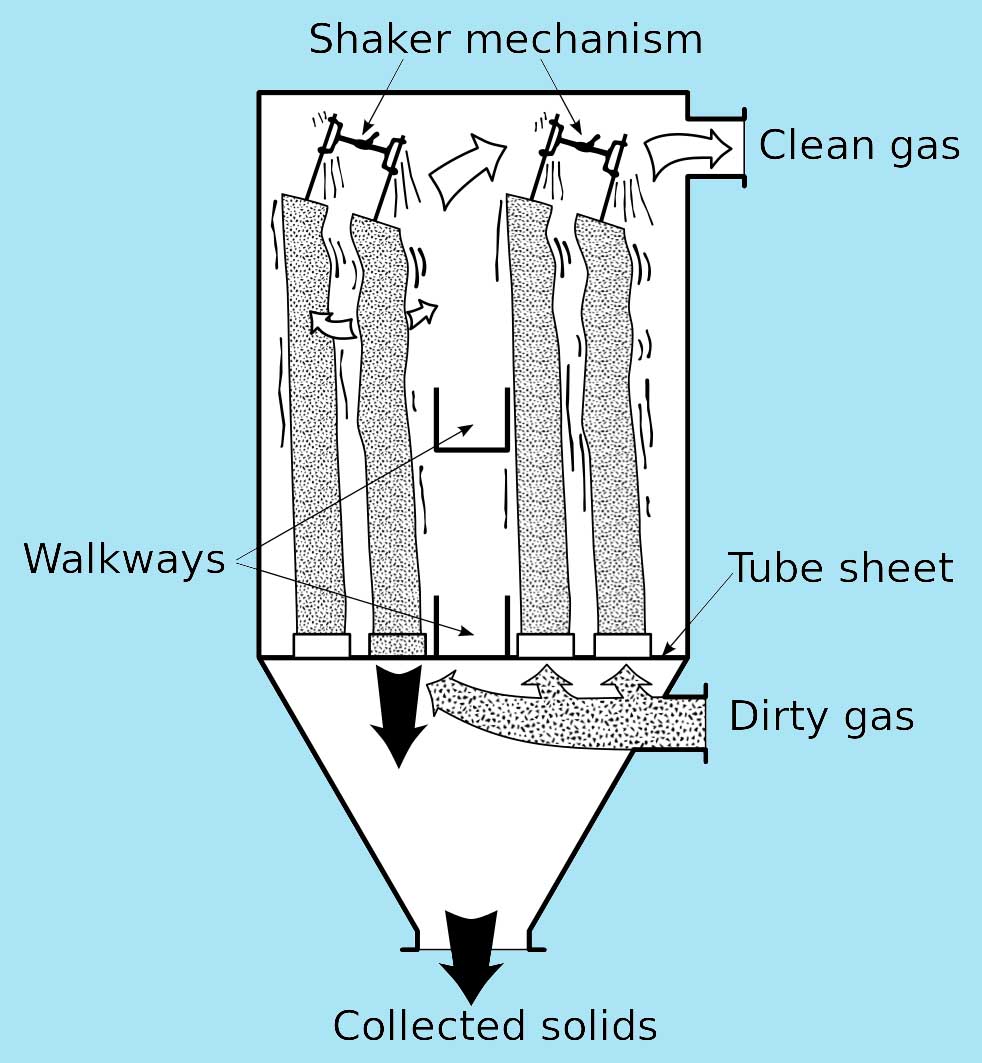
By Goran tek-en [CC BY-SA 3.0], via Wikimedia Commons

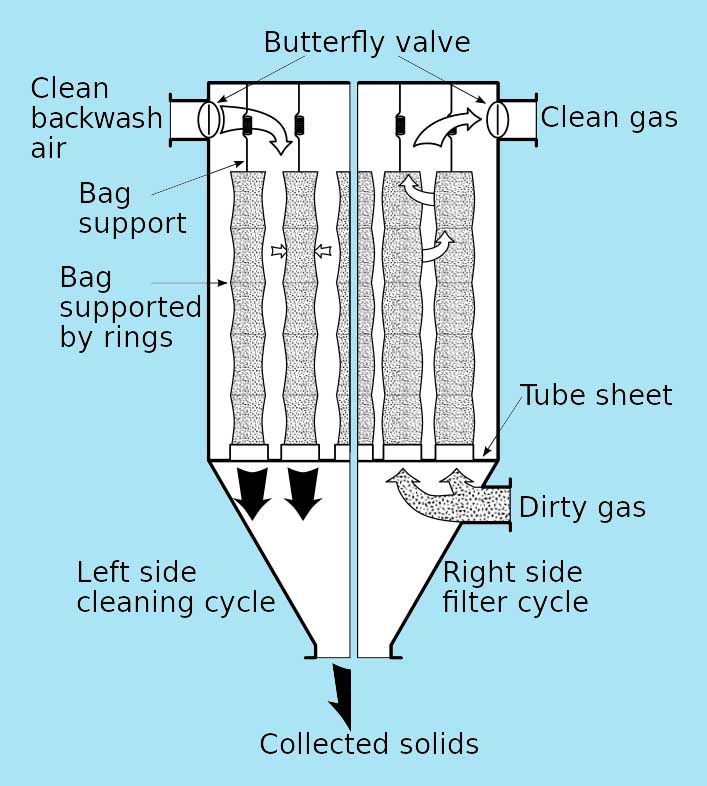
By Goran tek-en [CC BY-SA 3.0], via Wikimedia Commons

Reverse air
In a reverse air system, like in the mechanical shaker system, emission levels on the dirty side are never excessive, so even during the cleaning cycle the level of emissions would not typically be noticeable by Method 9 or Method 22. If there is a bag leak or mechanical break in the supporting superstructure of the filter media, emission levels will increase slowly over time as the break worsens. The increase in emissions is undetectable by Method 9 or Method 22 until the system is sufficiently broken to allow a visible emission through under normal operating conditions.
Failure of a reverse air system may take years between a detectable quick-check and a detectable Method 9 or Method 22.
Baghouse leak detection systems were developed to address this issue because the sensitivity can be tuned to ignore a normal level of emission and detect slight increases.
Pulse (pulse jet)
A pulse system uses a sudden release of compressed air to intensely knock all accumulated emissions off filter media. This pulse creates an intense cloud on the dirty side of the system — if there is a tear in a bag or crack in a tube sheet, the emission cloud will escape creating a puff of emission lasting less than one second. For this reason, when evaluating a pulse jet system, a Method 22 should be specified with either a duration sufficient to catch a cleaning cycle, or designed so the observation period includes a cleaning cycle. Such a puff of one second in duration has a 1 in 15 (less than 7%) chance of being detected by Method 9 during each pulse.
For a baghouse with a pulse every 6 minutes and a Method 9 observation lasting 6 minutes, there is a 1 in 15 (0.06667) chance of detecting the need for a repair. If the pulse cycle is determined by pressure drop, this may be greatly reduced since it is the frequency of the pulse that affects the probability.
If the pulse cycle is once an hour (typical in many applications), the probability drops to 1/150 or 0.6% — less than 1% chance it will be detected on any given observation. A problem could therefore last more than a year undetected by Method 9 Visual Opacity Observation.
A quick-check can often determine that the base level of emission during normal operation has changed, using the enhancement provided by the forward scattering effect of sunlight.
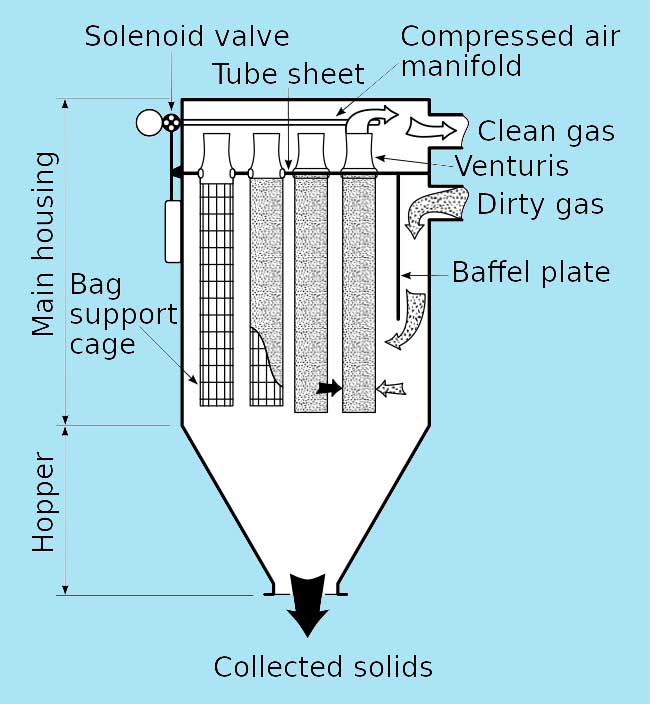
By Goran tek-en [CC BY-SA 3.0], via Wikimedia Commons

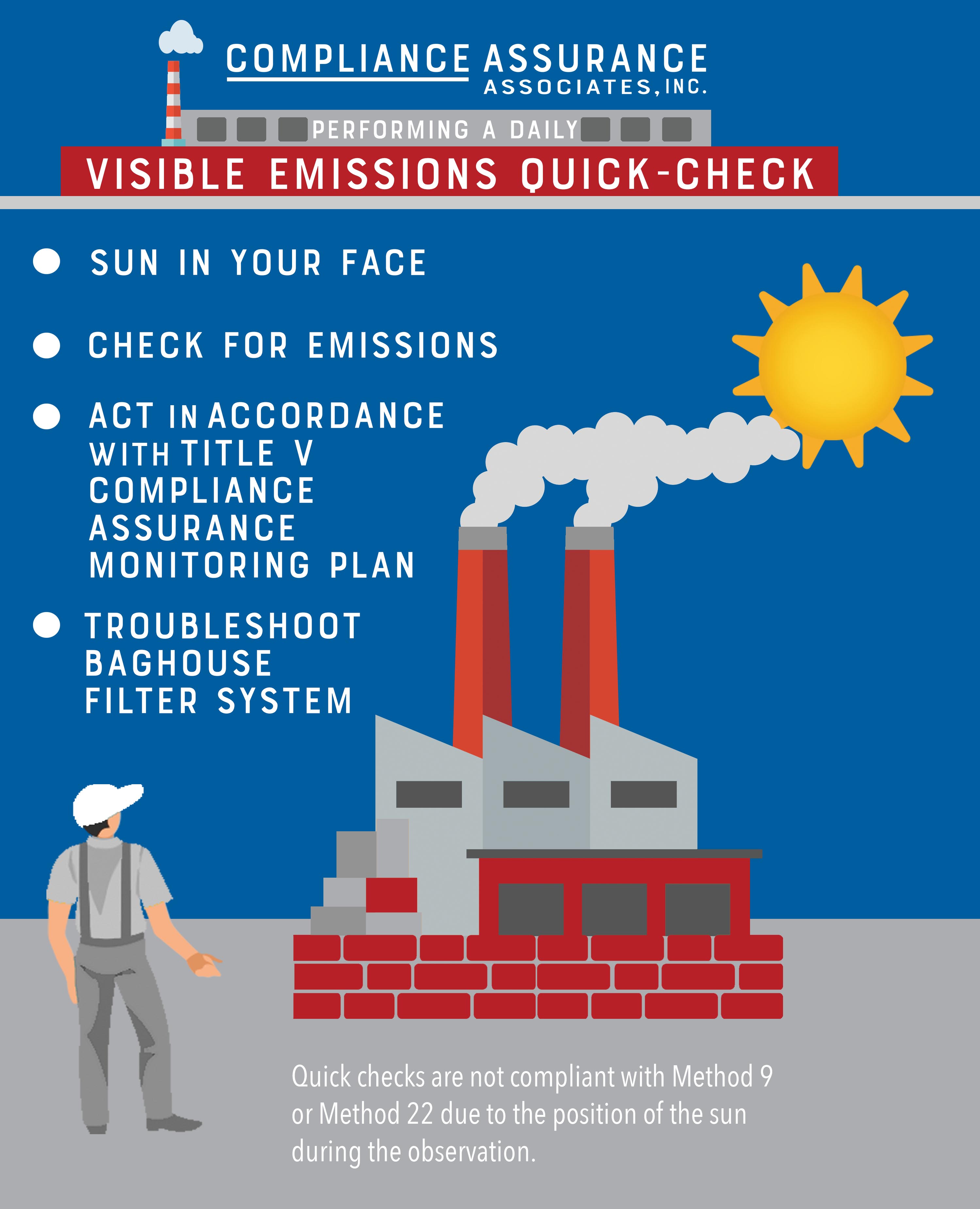
Visible emissions quick-checks*
Because of the tendency to have slow and gradual failure modes, it is difficult to ascertain early-stage baghouse problems with standard Method 9 and Method 22 procedures. This is one reason to perform quick-checks.
Depending on your EPA Title V Compliance Assurance Monitoring (CAM) plan, a daily quick-check may be built into your plan. A quick-check may be defined as: examine the facility or a list of affected sources daily — look daily, and if a visible emission is seen, initiate a Method 9 or Method 22.
If a quick-check finds detectable emissions above the baseline in your Title V, action is necessary as determined by your CAM. A Method 9 or 22 may be required, or a quick-check with the sun at your back to determine that required emission levels are not exceeded. Regardless of the required action, the quick-check becomes a valuable early detection system for baghouse operations.
*Quick-check terminology: If your organization is required to look at an emission source daily to determine if visible emissions are present, but a Method has not been specified, we use the term quick-check.