

Opacity Principles: Particulate Matter
How particle size and density affect visible emissions and opacity readings
Excerpt from Online Visible Emissions Course · Return to course summary »
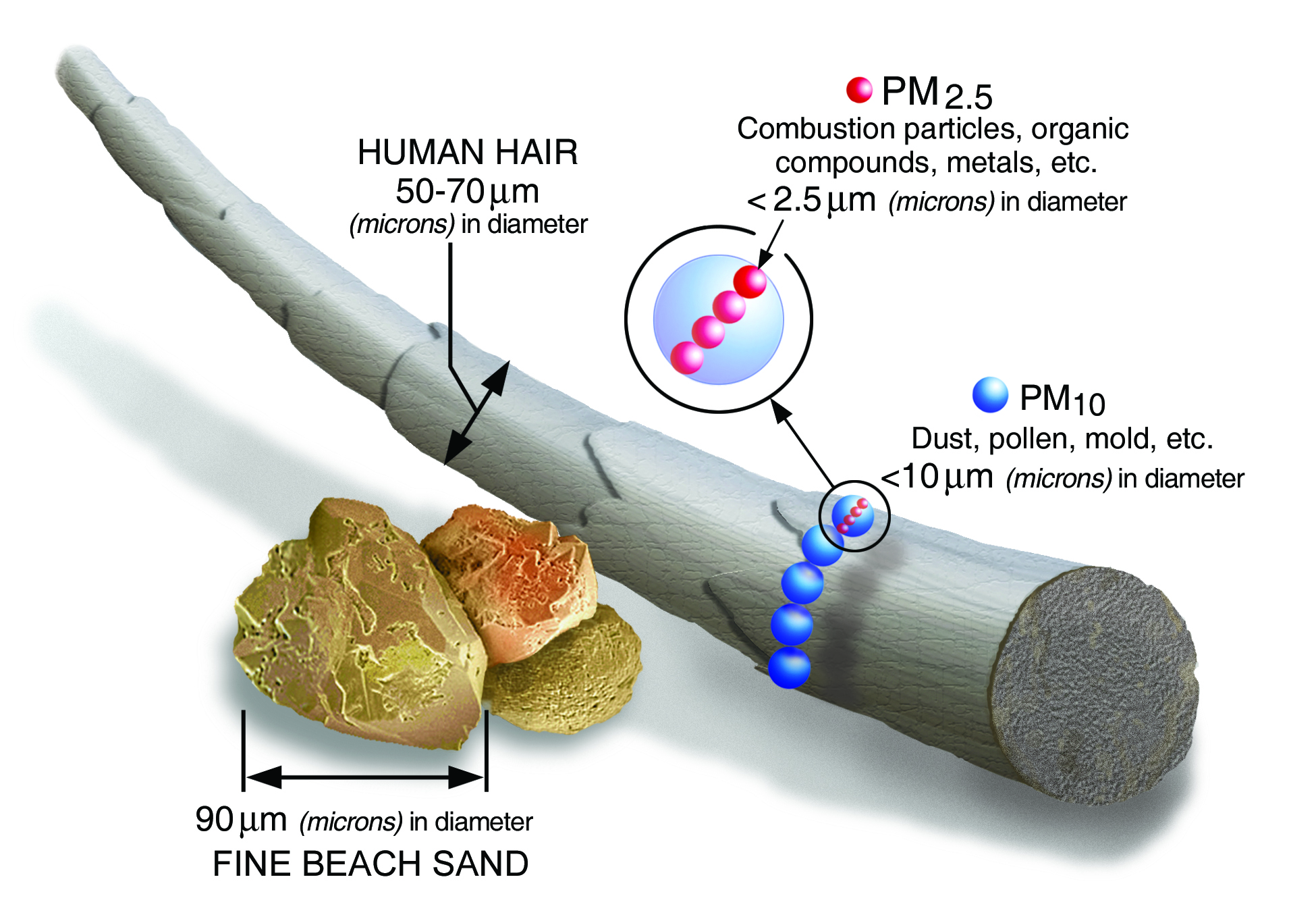
Click image to enlarge — directs to the EPA website.
Particulate matter
Particulate matter (PM), also known as particle pollution, is defined as a mixture of solid particles and liquid droplets found in the air. Examples of particulate matter include dust, dirt, soot, and fumes.
Particles in emissions range from 0.1 micron (also known as micrometer) to 200 microns. Microns are one-millionth of a meter and are designated with the µ symbol. For comparison, the width of a human hair is about 50–70 µm in diameter. EPA air pollution controls regulate particles up to 10 microns.
Particle size is significant because particles with diameters approximately equal to the wavelength of visible light (0.4 to 0.7 microns) have the greatest scattering effect and cause the highest opacity readings. Small particles are of special concern because they can be taken in by breathing — i.e., they are respirable.
Particles are notated using a subscript that reflects the particle's maximum size:
- PM10 particles are in a range from 0.5 to 10 microns and are respirable.
- PM2.5 particles are very small — 2.5 microns and smaller — and are also respirable.
For more information on particulate matter, visit the EPA particulate matter web page »
Particle density of an emission is the particles per volume of the emission. The higher the particle density, the more light is absorbed or scattered, and therefore, the higher the opacity of the emission.
A major goal of air pollution standards is to minimize the amount of particulates in the air. When there are more particulates in an emission, the emission has more density and a higher opacity reading.