

5 Field Conditions That Can Affect EPA Method 9 Opacity Readings
Accurate opacity readings depend on more than an observer’s ability to judge a plume. Under EPA Method 9, field conditions such as sun position, background contrast, condensed water vapor, viewing distance, viewing angle, and wind can all influence how visible emissions appear in the field.
Compliance Assurance Associates, Inc. (CAA) breaks down five common field conditions that certified visible emissions observers, EHS teams, and facility operators should understand before they become compliance concerns.
1. Sun Position
Sun position is one of the most important field conditions in a Method 9 opacity reading. Method 9 requires the sun to be within a 140° sector to the observer’s back. When the sun falls outside that sector, forward sca ttering can make a plume appear denser than it actually is, creating a positive bias in the reading.
Observers should confirm sun position before beginning an observation and continue to monitor it throughout, since the sun’s angle shifts as the observation proceeds. This is especially important in the middle of the day, when the sun is higher and the vertical sun angle plays a greater role in the 140° sector.
For a closer look at how sun position and vertical angle interact throughout the day, see CAA’s sun angle one-pager.
2. Background Contrast
Background contrast can make visible emissions appear either more or less opaque than they are. Too little contrast between the plume and the background can create a negative bias, making opacity appear lower than it is. Too much contrast can create a positive bias, making opacity appear higher.
For example, a dark plume against a bright sky may appear more visible because of the strong contrast, while a light plume against a pale or hazy background can be harder to distinguish. This is why observers are trained to describe background color precisely, using terms such as sky blue, cloud gray, or leaf green rather than vague descriptions.
3. Steam and Condensed Water Vapor
Condensed water vapor must be excluded from Method 9 opacity readings, though distinguishing steam from smoke in the field can require careful observation.
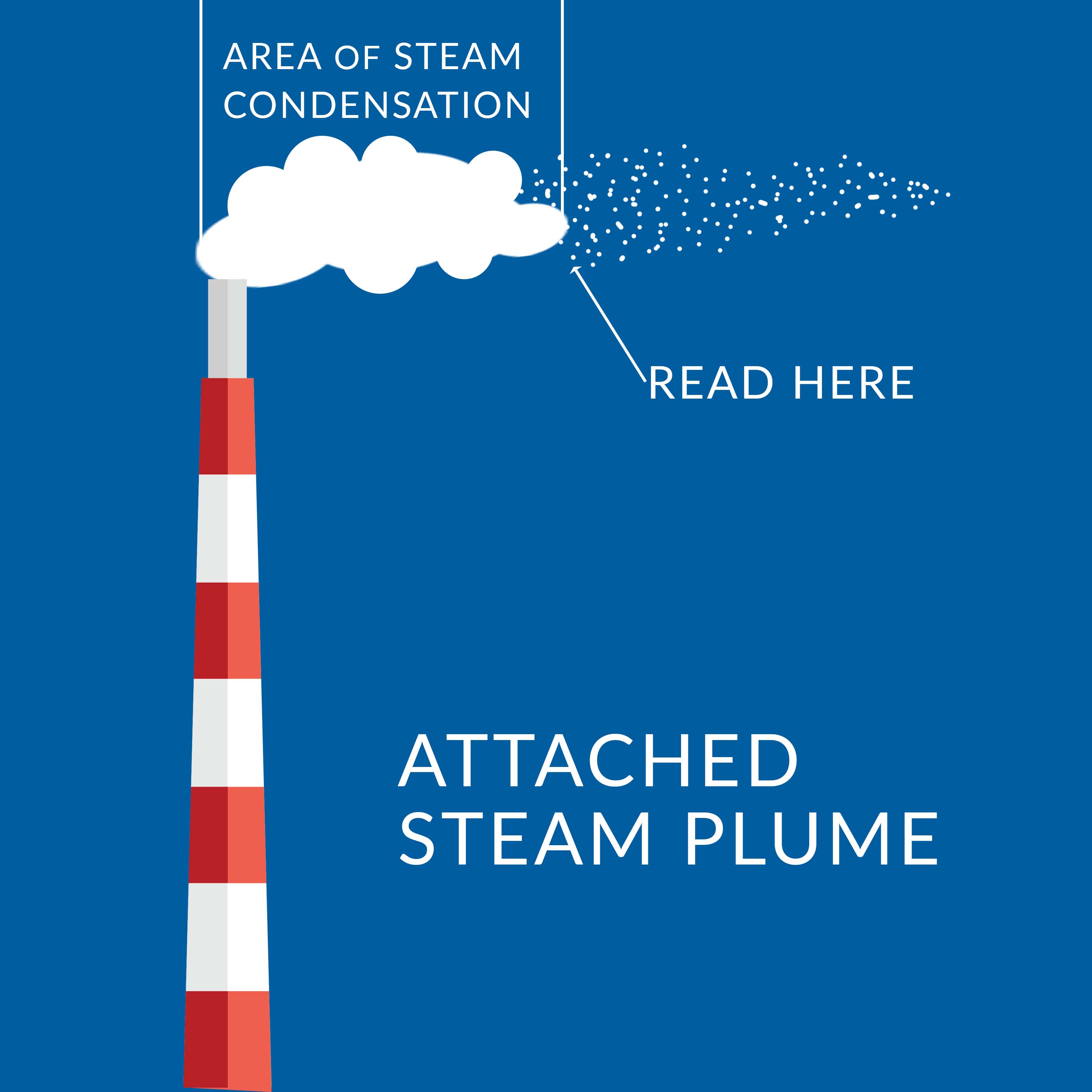
For attached steam plumes, where condensed water vapor is visible as the plume exits the emission outlet, observations are made beyond the point where the water vapor is no longer visible. See more about attached plumes
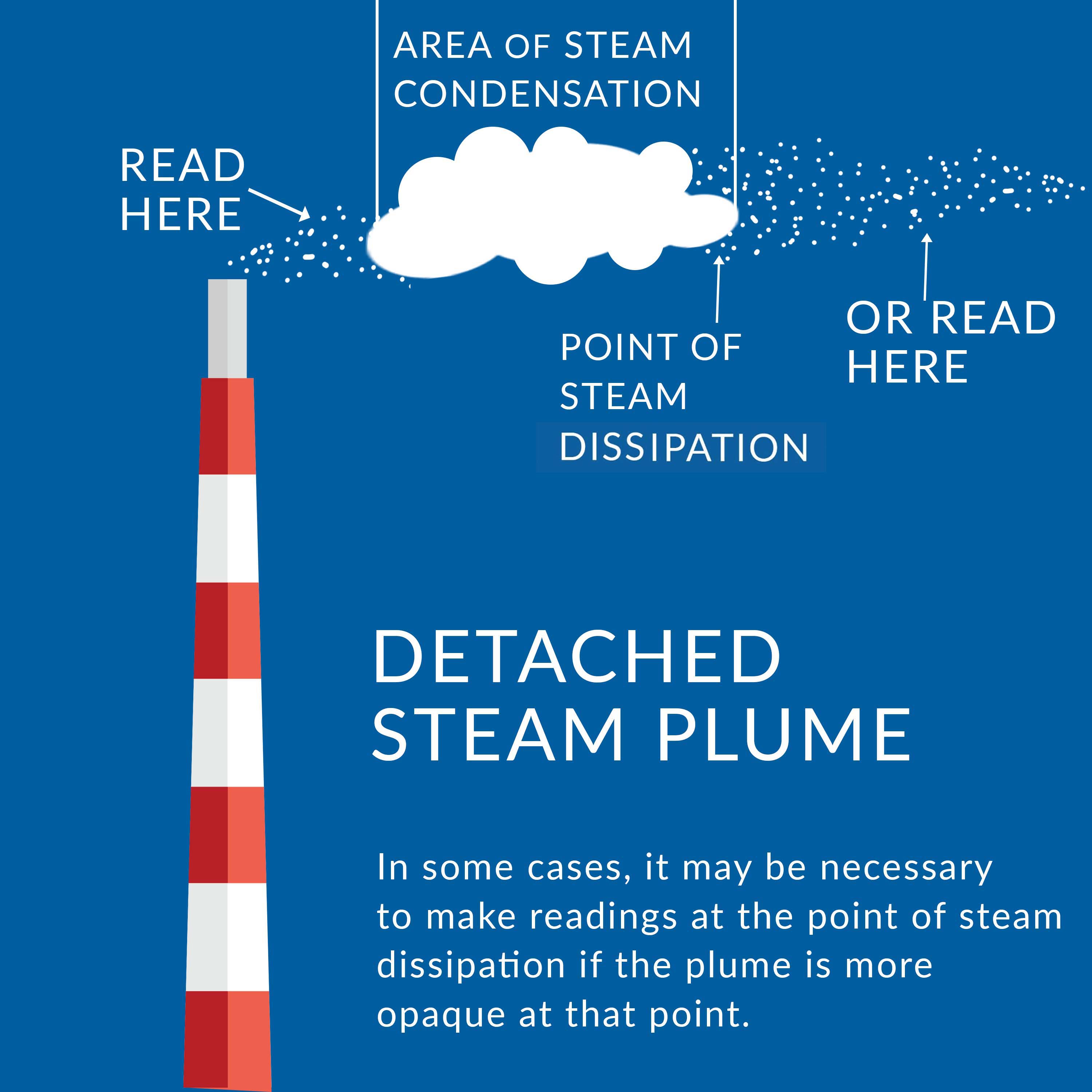
For detached steam plumes, where condensation forms at a distinct distance from the outlet, opacity is evaluated at the emission outlet, before the water vapor condenses.See more about detached plumes
Correctly identifying attached versus detached steam helps ensure the reading reflects visible emissions rather than condensed water vapor.
4. Viewing Distance and Angle
Observer position directly affects opacity accuracy. Method 9 requires the observer to stand at a distance that provides a clear view of the emissions, with the line of vision approximately perpendicular to the plume direction whenever possible.
Training guidance often uses the three-stack-heights relationship as a practical benchmark for maintaining an appropriate viewing angle on vertically rising plumes. The goal is to avoid an excessive slant angle through the plume, since a longer visual path can make emissions appear more opaque than they are.
Elevation matters too. If the observer is standing above or below the base of the stack, the minimum practical distance needed for an accurate view may change accordingly. Observers should document their position carefully and adjust when field conditions make the initial location unsuitable.
5. Wind Speed and Direction
Wind affects plume behavior, which in turn affects how visible emissions are read. Strong winds can flatten or fan a plume downwind before it fully disperses. Light or variable winds can cause the plume to loop, shift, or change direction during the observation period.
Because wind direction at the observer’s location may differ from wind direction at the emission source, observers should evaluate conditions at the source itself. Wind speed and direction should be recorded as part of the field documentation.
Frequently Asked Questions About Opacity Readings
Why is my opacity reading higher than expected?
An opacity reading may be higher than expected because of improper sun position, excessive background contrast, or an observation angle that creates a longer visual path through the plume.
Why is my opacity reading lower than expected?
Weak contrast between the plume and its background is a common cause of negative bias. Light-colored plumes against pale skies, haze, or bright backgrounds can be harder to distinguish accurately.
Does steam count as opacity?
Condensed water vapor is not included in Method 9 opacity observations. Observers must identify whether a plume has attached or detached steam and evaluate emissions at the appropriate point.
Does wind affect Method 9 readings?
Yes. Wind speed and direction shape plume behavior, and conditions at the source can differ from conditions at the observer’s location.
How often do Method 9 observers need certification?
Method 9 certification is valid for 6 months. Observers must repeat the qualification process to maintain current certification.
Key Points for Method 9 Observers
- Sun position outside the required 140° sector can create positive bias through forward scattering
- Background contrast that is too weak or too strong can bias readings low or high
- Condensed water vapor must be excluded from Method 9 opacity observations
- Attached and detached steam plumes require different observation points
- Observer distance and viewing angle affect the visual path through the plume
- Wind speed and direction at the source can shape plume behavior during the reading
Need Help Keeping Method 9 Observations Defensible?
Field conditions are never entirely within an observer’s control, but understanding how they influence visible emissions readings is an important part of defensible Method 9 compliance. Proper observer positioning, complete field documentation, and current smoke school certification all help facilities maintain reliable opacity records.
For questions about Method 9 certification, opacity readings, or visible emissions compliance, contact Compliance Assurance Associates, Inc. by email or by phone.
About CAA
Compliance Assurance Associates, Inc. (CAA) is a nationally recognized provider of smoke school training and opacity certification, helping facilities and certified observers navigate the field conditions and documentation standards that keep Method 9 visible emissions readings accurate and defensible.