

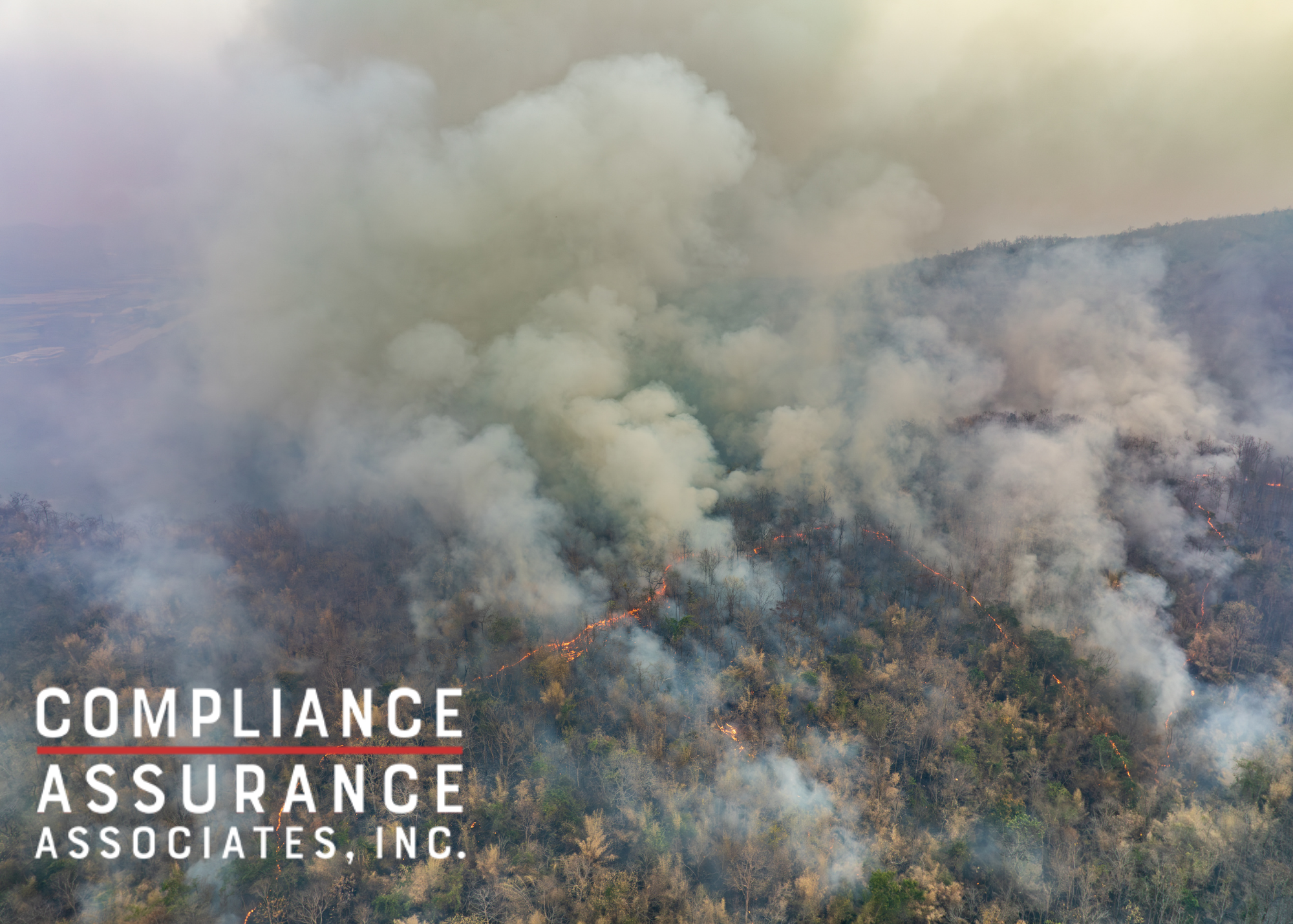
Wildfire smoke can create a seasonal challenge for facilities, EHS teams, and visible emissions observers working under EPA air quality regulations. During active fire season, smoke can blanket entire regions, elevate PM2.5 levels, reduce visibility, and complicate opacity observations that may have nothing to do with a facility’s own emissions. The EPA’s Visible Emissions Field Manual notes that Method 9 observations can be affected by field conditions such as background, lighting, distance, viewing angle, and plume characteristics.
Compliance Assurance Associates, Inc. (CAA) breaks down how wildfire smoke interacts with air quality standards, what it can mean for facilities near smoke-impacted areas, and how observers can document field conditions during EPA Method 9 opacity readings.
Wildfire Smoke and the NAAQS
Wildfire smoke is a major source of fine particulate matter, commonly referred to as PM2.5, during fire season. When smoke reaches regional air quality monitors, it can contribute to elevated readings and, in some cases, exceedances of the National Ambient Air Quality Standards, or NAAQS.
Understanding of the role wildfires play in regional air quality continues to grow as monitoring data and research expand. EPA’s Exceptional Events Rule reflects this evolving picture, providing a process for certain air quality monitoring data to receive special treatment when an event affects air quality and is not reasonably controllable or preventable. EPA identifies wildfires as one type of event that may qualify under this process.
However, wildfire-related exceedances are not automatically removed from the regulatory record. State, local, or tribal air agencies must prepare an exceptional events demonstration showing that the wildfire had a clear causal relationship to the specific monitored exceedance. EPA must then review and concur before the data can be excluded from certain NAAQS compliance determinations.
For facilities in or near nonattainment areas, this distinction matters. A wildfire-driven exceedance does not automatically change a facility’s permit status, but it may require careful documentation by the appropriate air agency before the monitoring data receives special regulatory treatment.
How Wildfire Smoke Can Affect Method 9 Opacity Observations
Wildfire smoke does not only affect ambient air monitors. It can also interfere with visible emissions observations in the field.
Regional smoke and haze can:
- Alter background contrast, making it harder to distinguish a facility’s plume from the surrounding sky or landscape
- Reduce visibility and complicate the clear-view requirement under Method 9
- Create potential confusion between regional smoke, nearby sources, fugitive dust, and the facility emissions being observed
- Increase the importance of complete field notes, including background, sky conditions, visibility, wind, and other possible interferences
EPA Method 9 requires observers to stand at a distance that provides a clear view of the emissions, with the sun positioned in the required 140° sector to the observer’s back whenever applicable. Method 9 guidance also recognizes that plume appearance can be affected by background, path length, distance, relative elevation, sun angle, and lighting conditions.
During wildfire season, those field conditions may change quickly. Observers should document ambient smoke separately from the plume under observation so the source and context of any opacity reading are clear.
What Facilities Should Do During Wildfire Season
The following recommendations reflect CAA’s field experience and general compliance best practices, not a separate EPA directive. Facilities with questions about a specific situation should contact their air agency or reach out to CAA for support.
Facilities operating in wildfire-prone or smoke-impacted regions can take several proactive steps:
- Monitor regional air quality alerts, wildfire activity, and smoke forecasts that could affect nearby observation conditions
- Brief visible emissions observers on how to document ambient smoke separately from facility emissions
- Record field conditions carefully during smoke-impacted periods, including visibility, sky conditions, background, wind direction, wind speed, and other potential interferences
- Retain supporting documentation, such as air quality alerts, smoke maps, photos, or field notes, when relevant to the observation
- Coordinate with the appropriate state, local, or tribal air agency if wildfire smoke is expected to affect regulatory monitoring in the area
Frequently Asked Questions
Does wildfire smoke count against my facility’s opacity readings?
Wildfire smoke does not directly count as a facility emission, but it can make field observations more difficult by affecting visibility and background contrast. Observers should document ambient smoke separately from the plume being evaluated.
Can wildfire-related exceedances be excluded from NAAQS compliance records?
Yes, in certain cases. Under EPA’s Exceptional Events Rule, affected monitoring data may receive special treatment if the appropriate air agency demonstrates a clear causal relationship between the wildfire and the specific exceedance and EPA concurs.
Should facilities pause Method 9 observations during heavy smoke events?
Not necessarily. However, observers should evaluate whether they still have a clear view of the emissions and should document smoke, haze, wind, background, and other field conditions carefully. If conditions interfere with the validity of an observation, that should be clearly noted in the field record.
What should Method 9 observers document during wildfire smoke events?
Observers should document the source being observed, background conditions, sky conditions, visibility, wind speed and direction, sun position, observation point, and any visible regional smoke or haze that could affect the reading.
How can facilities prepare for the wildfire season?
Facilities can prepare by reviewing field documentation procedures, keeping observers current on Method 9 certification, monitoring regional smoke conditions, and maintaining clear records during smoke-impacted periods.
Key Points
- Wildfire smoke can elevate PM2.5 levels and affect regional air quality monitoring during fire season
- EPA’s Exceptional Events Rule provides a process for certain wildfire-influenced monitoring data to receive special treatment in NAAQS determinations
- Air agencies must demonstrate a clear causal relationship between the wildfire event and the specific exceedance before EPA can concur
- Regional smoke can complicate Method 9 opacity readings by affecting background contrast, visibility, and field conditions
- Observers should document ambient smoke separately from facility emissions
- Strong field records help protect the integrity of visible emissions observations during smoke-impacted periods
Stay Ahead of Seasonal Air Compliance Challenges
Wildfire season can add complexity to air quality compliance, especially when smoke affects visibility, background conditions, or regional PM2.5 monitoring. Facilities cannot control wildfire smoke, but they can control the quality of their documentation and the readiness of their visible emissions observers.
For help preparing your team for seasonal field conditions, EPA Method 9 certification, or visible emissions compliance, contact CAA by email or phone.
About CAA
Compliance Assurance Associates, Inc. (CAA) is a nationally recognized provider of smoke school training and opacity certification, helping facilities navigate visible emissions requirements embedded in Title V permits, State Implementation Plans, and other air compliance programs.